


Richard Selwyn
Resources & Strategy Policy Committee Vice Chair
Service Director Children's Commissioning
Somerset Council
When the last champagne cork pops, the new government will reflect on quite a challenge. We are trapped in a perfect storm with poverty, homelessness, health, justice, the number of children in care and quality of life all getting worse. The economy has slumped over the last 20 years. And as we all know, local services are on their knees, putting pressure on other parts of the system and failing our population.
There is a stark choice… 1) a managed decline in the standards and outcomes we expect, or 2) we do something different. The risk of standing still is now much higher than the risk of change.
The reason all of us got into this job was to make a difference for children and families. That’s why we have to choose the second option… to redesign our system of services, partners, community and families, and win the argument for early help. And there is a great argument for early help — not only the Supporting Families evaluation that looked at just a few outcomes and proved a £2.28 return on every £1 of investment. But also the 14-year austerity experiment that left us with stripped back early help and led to much higher acute costs and worse outcomes.
So, what does effective community-based early help look like?
There’s a pretty good description in the DfE Early Help System Guide, and I wanted to pick out a few things that have made the biggest difference in Somerset and other local areas I’ve worked:
- The first thing is a principle of growing early help in localities. Localities are important because a smaller patch (30k to 50k population) encourages professionals to get to know each other and the local community resources they can connect families to. We can’t impose or import a new model, but we can set the conditions that will nurture and grow a community model of early help. We can remove barriers such as IT and geography and get out of the way.
- The second change, which made the biggest difference in Somerset and Birmingham, is to appoint Champions to lead the public sector changes. Champions are local community leaders funded for perhaps three days of their time each week. By empowering community leaders, we are rebalancing the power between public sector and community sector — creating a symbiotic relationship that characterises a progressive approach. It’s not going to work if we impose on our communities.
- Hubs are important for accessing support. We’re moving away from creating buildings that we expect people to come to, and instead placing our services in hubs that feel like they belong to the community and that families are comfortable to access. To reduce inequality, we need to lower the threshold to get over the threshold. In Somerset we think we have around 100 community places that can be wonderful hubs — this improves rural access and then we can deliver a Family Hub offer distributed across the 100.
- During Covid-19, some of our schools refocused on education and effectively closed themselves off from their community. But schools can be amazing anchors in their community. One example in Somerset is Holyrood Academy in Chard which hosts twice-termly breakfasts for community leaders and is galvanising the community to develop a hub, raise funding and tackle challenges such as youth violence. Supporting GP surgeries, pharmacies, nurseries and schools to be community anchors is an important foundation for building social capital — the first step is linking them to local community resources.
- And finally, the tech is critical. We can reduce barriers between professionals and encourage relational practice by sharing case management and multi-agency data, like our Transform app. And we can use the same data to predict who needs help and make sure they have help earlier — building families’ resilience and reducing demand to acute services. Predictive targeting will be a step-change in the effectiveness of early help.
Through Connect Somerset we are doing something different to re-imagine the whole model of public sector delivery. More early help, a symbiotic model with our communities, new tech, and rebalancing funding from acute to prevention.
So, we need the new Government to be an enabler of community early help — through new initiatives such as a reimagined Total Place, new investment that will generate savings for the Treasury, and securing early help on a statutory footing.
Next time a S114 Commissioner comes knocking, all councils need to be clear that our legal duty for best value is delivered through community early help.
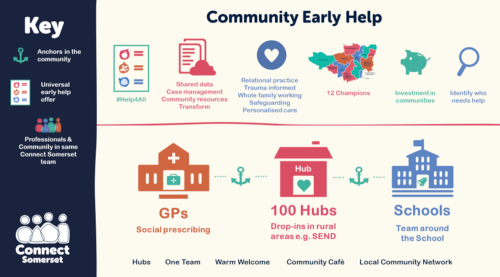
Key features of the Connect Somerset early help programme
- Early Help System Guide describing community early help
- Connect Somerset Blueprint and resources and Transform app
- Supporting Families evaluation evidences the return on investment of early help
- Bowling Alone research is proof that higher social capital improves education, health and safety.